How to Design Branded Food Wrap
- May 25, 2026
- News
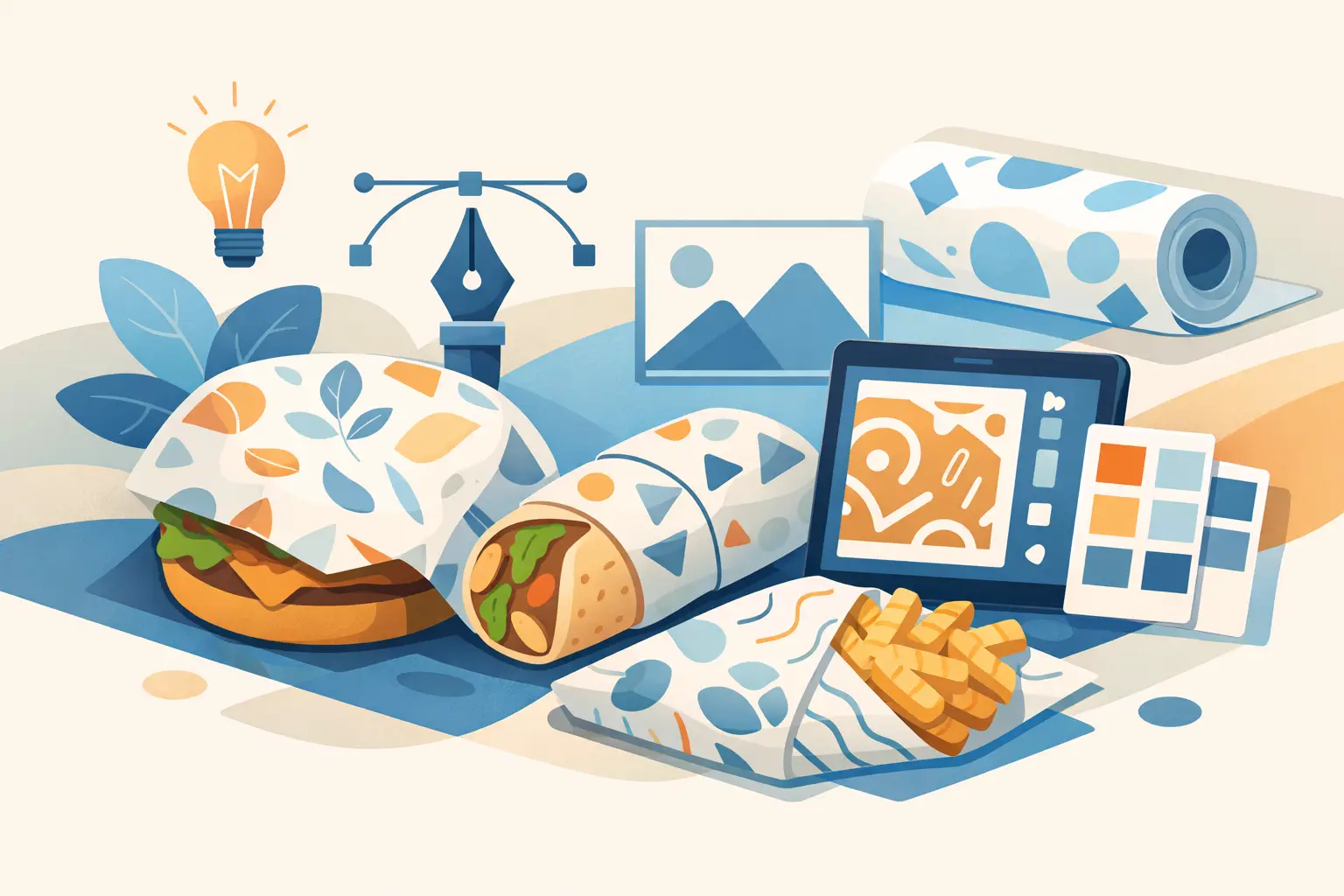
A burger wrapped in paper gets handled more than most menus. It is picked up, folded, passed across the counter, photographed, unwrapped and binned within minutes. That is exactly why learning how to design branded food wrap matters – it is one of the hardest-working branded items in any food business.
Good food wrap does two jobs at once. It needs to present the product properly, and it needs to perform in a real service environment where speed, grease, heat and consistency all matter. If the design looks good on screen but fails when wrapped around a hot sandwich or lining a basket of loaded fries, it is not doing the job.
Start with service, not just artwork
The most common mistake is treating food wrap like a flat flyer. It is not a poster, and it is not standard print collateral. Branded greaseproof paper is a working packaging material, so the design has to suit how the food is wrapped, lined or served.
Before you think about logos or colours, be clear on the use case. A bakery sheet used to present cakes in a display case needs a different design approach from a burger wrap, pizza box liner or fish-and-chip serving sheet. Some businesses need the paper mainly for presentation. Others need it to contain the product during takeaway service. In many cases, it has to do both.
That affects sizing, print scale and layout. If your team wraps quickly during peak hours, a busy edge-to-edge design may not matter as much as having a repeat pattern that still looks branded from any fold. If the sheet is mainly used as a tray or basket liner, then a more open layout with stronger central branding can work well.
How to design branded food wrap for real food products
The right design starts with the product itself. Think about what the customer will actually see once the food is wrapped or presented. A large central logo might disappear completely once folded. A small repeated logo or simple brand motif often performs better because it remains visible from multiple angles.
This is where repeat print design usually makes commercial sense. It gives consistent branding across every sheet, reduces the risk of hidden artwork and keeps the wrap looking tidy whether it is used for burgers, sandwiches, burritos or baked goods. It also tends to age better than trend-led graphics that can date quickly.
That said, repeat print is not the only option. If you are lining trays, wrapping smaller items or using larger bespoke sheets, you may have room for a more structured layout. The key point is that the design should match how the sheet will be handled in service.
Grease and moisture also change how print is perceived. Fine detail can get lost. Very light artwork may disappear against food shadows or textured presentation. Designs with clear contrast and enough spacing usually hold up better.
Keep the branding simple and recognisable
Strong food wrap design is usually less complicated than people expect. Most hospitality brands do not need a full campaign-style layout on greaseproof paper. They need consistent branding that looks clean, repeats well and reinforces the identity customers already know from signage, menus and social media.
In practice, that means focusing on a few core elements. Your logo is the obvious starting point, but it does not always need to be the only graphic. A secondary icon, strapline or simple pattern drawn from your wider brand can work well if the overall design stays uncluttered.
Be careful with text-heavy layouts. Small type can become unreadable once folded, and excessive messaging can make the sheet feel crowded. If you want to include a slogan, keep it short and make sure it remains legible at print size.
Colour choice also needs some discipline. Brand colours should be used consistently, but food wrap is not always the place for a complex palette. Simpler designs often print more clearly and look more premium in use. It depends on the brand, of course. A bold takeaway concept may suit a louder print. A bakery or café may benefit from a more restrained approach.
Choose the right sheet size early
Design and size should be decided together. This is where many orders lose efficiency. If you create artwork before confirming the sheet dimensions, you can end up reworking the design or settling for a layout that does not fit the product properly.
Think about the foods you serve most often and how much coverage each one needs. A sandwich wrap needs enough room for folding without leaving too much excess paper. A basket liner needs to sit neatly without bunching. A burger sheet needs to cope with handling and presentation at the same time.
If you use more than one food format, it may be tempting to choose a single sheet size for everything. Sometimes that is practical. Sometimes it creates compromise. One standard size can simplify stockholding, but it may not deliver the best presentation across every menu item. Bespoke sizing can improve fit and reduce waste, especially for operators with specific pack formats or established portion sizes.
Design for print, not just for screen
Artwork that looks sharp on a monitor can behave differently in print. That is especially true on greaseproof paper, where material finish and food use need to be taken into account.
Clean vector artwork is usually the safest route for logos and repeating elements. Resolution matters for any raster images, but in most cases photographic or highly detailed artwork is not the strongest choice for food wrap. Simpler graphic design tends to reproduce more consistently and remain clearer in service.
Line weight matters too. Very thin lines and tiny details may not hold up as well as expected. The same goes for tightly packed elements in repeating patterns. Giving the artwork enough breathing space usually improves legibility and overall print quality.
Proofing is not an administrative extra. It is part of getting the result right. A proper visual check helps confirm scale, spacing, repetition and overall balance before production. For busy food businesses, this step saves time because it reduces the risk of ordering stock that looks fine in a file but underperforms on the counter.
Think about food presentation and customer perception
Customers notice packaging quickly, even when they do not say so directly. A branded wrap can make standard menu items feel more considered and more professional. That matters for dine-in presentation, takeaway handover and online photos.
The point is not to overdesign it. The point is to make the product look consistent. A good sheet frames the food, supports the brand and adds perceived value without getting in the way. If your packaging looks generic, the customer experience often feels generic too.
This is particularly relevant for independents competing against larger chains. Branded food wrap helps create a repeatable identity across every order, whether you are serving burgers, toasties, pastries or fish and chips. It gives your team a more polished presentation without slowing service.
Do not ignore material performance
No matter how good the print looks, the paper still needs to work as food packaging. Grease resistance, durability and suitability for the intended food types all matter. Hot, greasy products place very different demands on a sheet compared with dry bakery items.
That is why the design process should never be separated from the packaging specification. If the sheet is too lightweight for the job, or not suitable for the product, the branding will not rescue it. Food wrap should support handling, presentation and practical use together.
Sustainability also comes into the decision. Many operators now want branded wraps that align with customer expectations around recyclable, compostable or biodegradable materials. That does not mean choosing on claims alone. It means making sure the material suits your service model while meeting your environmental goals.
Make ordering easy for your team
The best branded packaging is repeatable. Once your design is right, reordering should be straightforward, with the artwork approved, sizes confirmed and production expectations clear.
That is why operational support matters. Mockups help buyers visualise the final result before committing. Proof approval keeps the process controlled. Sample requests can help if you need to compare sizes or assess how the paper feels in use. Fast turnaround is valuable, but only when the approval process is clear enough to avoid mistakes.
For UK hospitality businesses working to tight service schedules, a supplier that understands food packaging rather than generic print can make the process much easier. Greaseproof Packaging, for example, focuses on custom printed greaseproof paper with proofing support, flexible sizing and a defined delivery window that fits commercial ordering needs.
A practical approach to how to design branded food wrap
If you want the design to work long term, keep the brief tight. Start with the food type, the sheet size and the service use. Then build a simple branded layout that stays visible when folded, prints clearly and reflects the look of your business without overcomplicating the sheet.
The strongest results usually come from restraint. A clean repeated logo, the right scale, suitable paper and a proper proof will outperform a clever-looking design that ignores handling and presentation. Food wrap is not there to carry every brand message. It is there to make the product look right, work properly in service and leave the customer with a stronger impression of your business.
If you treat it as part of operations rather than an afterthought, branded food wrap becomes one of the easiest ways to improve consistency across every order.
Continue reading
- © 2026 Greaseproof Packaging
- Registered: SC759437
- VAT Reg No: 444972955
- © 2026 Greaseproof Packaging
- Registered: SC759437
- VAT Reg No: 444972955