Custom Deli Liners That Work Harder for Your Brand
- October 27, 2026
- News
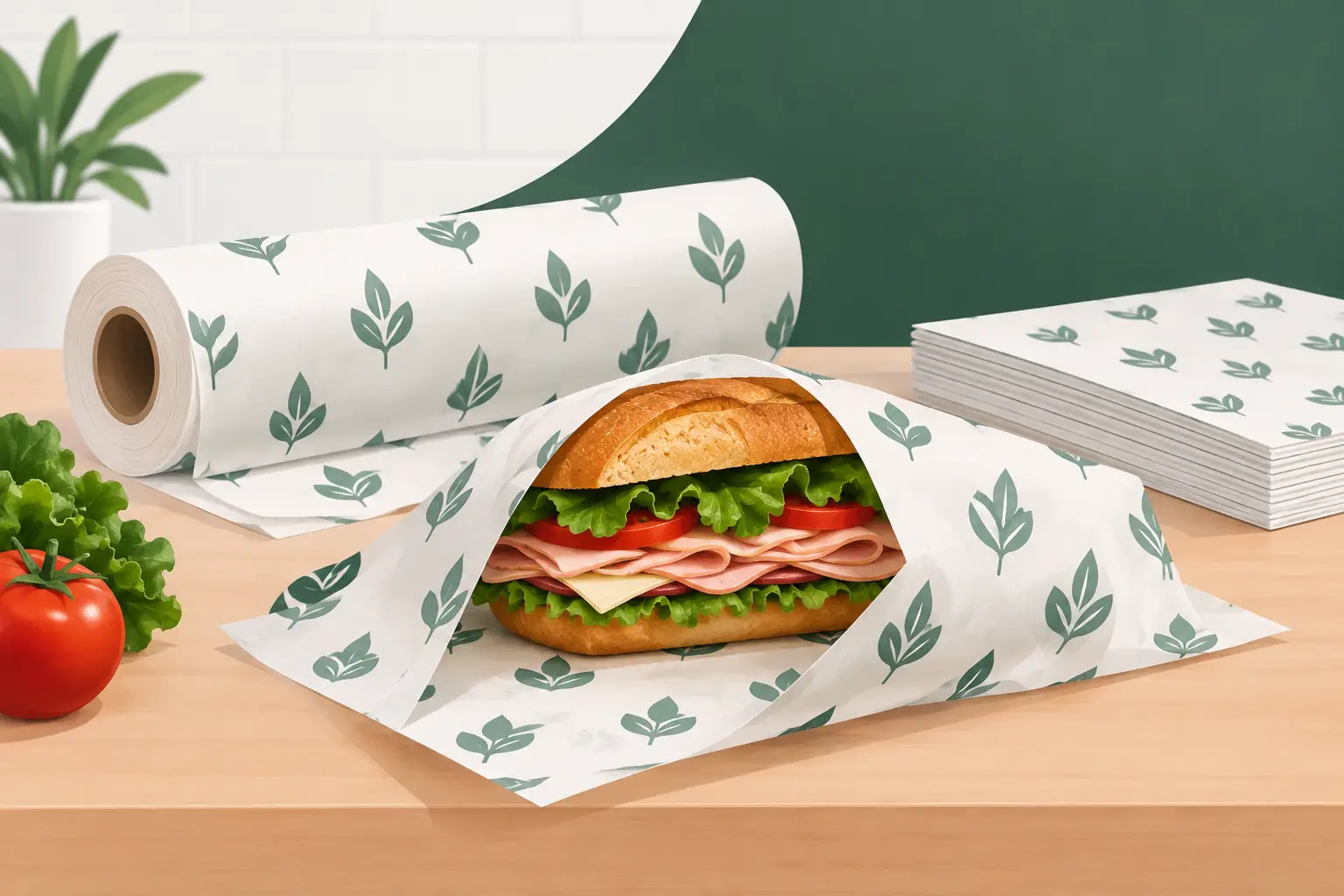
A burger wrapped in plain white paper may leave the kitchen looking perfectly acceptable. By the time it reaches a customer, it is a missed branding opportunity. Custom deli liners put your name, logo or repeat pattern in the customer’s hands at the point where food presentation matters most – while keeping trays, baskets, boxes and counters cleaner.
For busy cafés, takeaways, restaurants and caterers, the right liner is not a decorative extra. It needs to suit the food, fit the serving format and arrive reliably when stock is needed. The practical details – paper size, print coverage, grease resistance and ordering lead time – determine whether branded paper supports service or creates another problem for the team.
What custom deli liners do in a working food business
Deli liners are greaseproof sheets used to wrap, line or separate food. They are commonly placed in burger boxes and baskets, beneath sandwiches and cakes, around burritos, under fries or alongside fish-and-chip servings. They can also help prevent sauces, oils and crumbs from transferring to trays, packaging or customers’ hands.
When printed with your branding, the same sheet becomes a consistent part of the customer experience. A distinctive logo pattern can make a simple grab-and-go sandwich look considered. For delivery orders, where your team is not present to explain the brand, it gives the packaging a more recognisable, professional finish.
There is a commercial benefit too. Strong presentation helps food look more deliberate in customer photographs and social posts without changing the recipe or adding time to the pass. This is particularly useful for independent operators competing with larger chains that already have established visual identities.
Choosing custom deli liners for the food you serve
The best specification depends on how the paper will be used. A liner for a dry pastry does not need to perform in the same way as a freshly dressed burger or a portion of chips. Start with the product and serving method, then select the paper size and print design around it.
Match the sheet size to the job
A sheet that is too small exposes the tray or fails to wrap the product properly. One that is too large can be wasteful, slow down wrapping and create unnecessary bulk inside a box. For this reason, it is worth measuring the actual basket, box, plate or finished food item rather than estimating from a menu description.
Smaller sheets often suit cakes, pastries, side portions and sandwich baskets. Medium formats can work well for burgers, wraps and deli-style sandwiches. Larger sheets are useful for pizza slices, loaded fries, burritos and full wraps. Bespoke sizes can be worthwhile where standard dimensions leave too much excess paper or do not cover the food consistently.
For operations with several menu formats, using two or three carefully chosen sizes is usually more practical than trying to make one sheet do everything. It gives staff a clear, repeatable routine while keeping stock control manageable.
Plan the print for real service conditions
A custom print should be visible without making the paper look overcrowded. Repeat logos, simple icons, short straplines and bold brand marks generally reproduce clearly and remain recognisable even when the sheet is folded, crumpled or partly covered by food.
Fine detail can be less effective than expected on a small liner, especially where a large logo is broken across several folds. A repeat pattern often solves this problem because the branding remains visible from more than one angle. Dark, high-contrast artwork may also give a stronger result than pale elements with limited definition.
Think about the customer’s view, not just the flat artwork. If the liner will wrap a burger, place key design elements so they are likely to show on the outside. If it will line a basket, make sure the pattern still works when a large part of the sheet is hidden beneath the food.
Use artwork proofing before production
Artwork approval is a necessary control, not a formality. A proof allows you to check logo placement, scale, colour direction, repeat layout and the final sheet dimensions before the job is manufactured. It is the point to spot a phone number that is too small, a logo that sits too close to an edge or a pattern that looks overly dense.
Where there is any uncertainty, request a mock-up or sample first. This is especially sensible for a new brand identity, a first large order or a liner that must fit a particular box or tray. Checking early is faster and less expensive than correcting an approved design after production.
Food protection, sustainability and the trade-offs
Greaseproof paper is chosen because it helps manage oils and moisture during normal foodservice handling. It is a practical option for many fried, grilled and baked foods, but it is not a substitute for a fully sealed container. Very saucy dishes, extended delivery times or high-moisture foods may need a suitable box, tray or secondary pack alongside the liner.
This distinction matters. A branded sheet can improve the appearance of loaded fries or wings, for example, but the outer packaging still needs to contain heat, sauce and movement during transport. Build the liner into the full packaging system rather than expecting one material to solve every handling issue.
Eco credentials should be considered with the same care. Biodegradable, compostable and recyclable paper options can support lower-impact packaging choices and meet growing customer expectations. However, disposal routes vary by local authority and by the type of food contamination involved. Claims should therefore be matched to the specific material selected and to the waste facilities available to your business or customers.
Choosing a paper liner also brings a useful operational advantage: it can reduce direct contact between food and reusable serviceware or trays, helping make clearing down simpler between orders. For dine-in venues, that can protect presentation while making the table reset feel more consistent.
Making ordering straightforward
Custom packaging should not require a complicated procurement process. Before placing an order, have the finished artwork available in a suitable format, confirm the sheet size and decide whether the liner is primarily for wrapping, lining or both. It also helps to consider how many sheets the team uses each week, rather than ordering purely around an arbitrary quantity.
A reliable supplier should make the next steps clear: upload artwork, review a mock-up, approve the proof, then move into production. At Greaseproof Packaging, custom printed greaseproof paper is manufactured in the UK, with a stated delivery window of 5-7 working days from proof approval. That clarity is valuable when a new opening, menu launch or event has a fixed date.
Do not leave reordering until the last sleeve is in use. Build lead time into your stock planning and keep a sensible buffer for busy weekends, seasonal trading and unexpected demand. Once a size and design are working well, repeat orders become far easier to manage.
Where branded liners make the biggest difference
Custom deli liners tend to deliver the strongest return where the food is handled, photographed or carried away. Burger shops can use them to make every box opening feel more branded. Sandwich bars can create a consistent presentation across display items and takeaway orders. Bakeries can add a polished finish to pastries without investing in fully printed boxes for every product.
For caterers and event traders, liners are particularly useful because they bring brand consistency to temporary counters, hired trays and mixed serving equipment. A simple printed sheet can make a pop-up setup look established, even when the menu is changing quickly.
The key is consistency. Use the same visual language across wraps, basket liners and serving paper so customers recognise the business before they read the logo in full. That repetition turns an everyday consumable into part of the identity customers remember.
A well-sized, properly proofed liner will not slow your team down. It should be easy to grab, fit the food naturally and leave every order looking like it came from the same confident operation.
Continue reading
- © 2026 Greaseproof Packaging
- Registered: SC759437
- VAT Reg No: 444972955
- © 2026 Greaseproof Packaging
- Registered: SC759437
- VAT Reg No: 444972955