Can Greaseproof Paper Be Recycled in the UK?
- October 29, 2026
- News
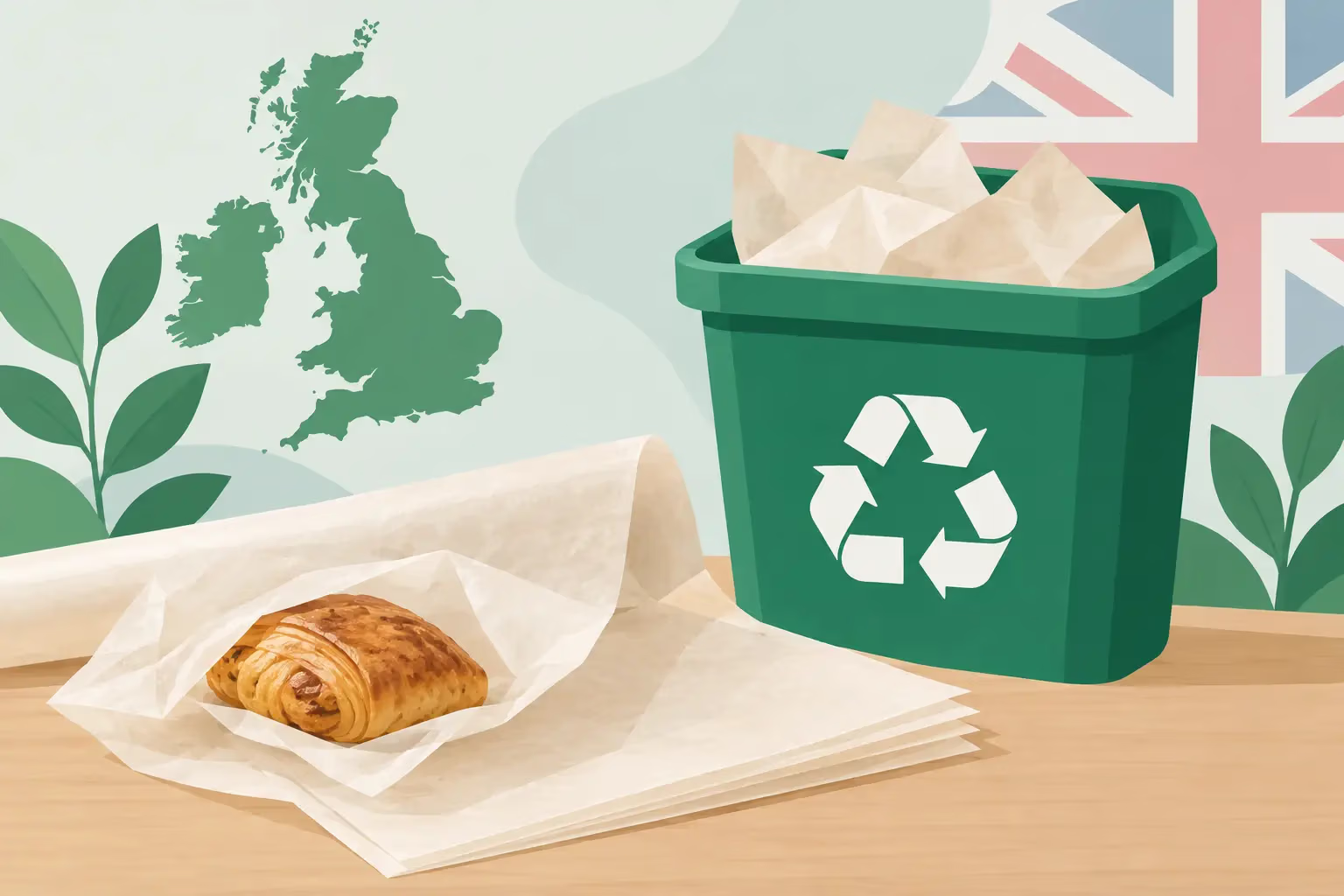
A burger wrap can look like ordinary paper, but its route after service is not always ordinary paper recycling. Can greaseproof paper be recycled? Sometimes, but the correct answer depends on the paper’s coating, how heavily it has been used, and the collection rules used by your local authority or commercial waste provider.
For food businesses, this is more than a disposal detail. Clear guidance helps staff sort waste consistently, supports credible sustainability messaging and prevents recyclable materials being rejected because they have been placed in the wrong bin.
Can greaseproof paper be recycled?
Clean, uncoated greaseproof paper may be accepted in some paper recycling streams. However, many used sheets are not suitable for recycling because they are stained with oil, sauce, cheese or other food residue. Grease contamination affects the quality of recovered paper fibre and can make a whole load harder to process.
The term “greaseproof paper” also covers more than one material. Some papers achieve grease resistance through the way the paper is made. Others use a surface treatment or coating, such as silicone. A paper-based product may still look and feel recyclable, yet the coating can affect whether a specific recycling facility accepts it.
That means no responsible food operator should apply one disposal rule to every greaseproof sheet. Check the technical information for the product you buy, then confirm what your waste contractor or local collection scheme accepts. In the UK, household and commercial collections vary considerably by area and provider.
The three factors that decide the answer
1. The type of greaseproof treatment
Traditional greaseproof paper is made by refining the pulp so the finished sheet has a dense structure that resists oil penetration. Depending on the grade, this may be easier to recycle than paper with a plastic-based barrier layer.
Silicone-coated paper is commonly used where stronger release performance is required, particularly for baking and certain hot food applications. Silicone is applied in a very thin layer, but acceptance still depends on the recycler’s process. Do not assume that a sheet is recyclable simply because it is paper-based, or that it is not recyclable simply because it is coated. Product specifications matter.
The same principle applies to other food wraps. A waxed, laminated or plastic-lined sheet should not be placed in a standard paper recycling bin unless your waste provider specifically confirms that it is accepted.
2. How much food contamination is present
A fresh, unused offcut from a preparation area is very different from a sheet that has wrapped a loaded burger or lined a portion of chips. Light marks may be manageable in a specialist commercial stream, but a sheet saturated with fat or covered in food is unlikely to be suitable for paper recycling.
This is especially relevant for quick-service businesses. The packaging is doing its job by holding oils and moisture away from the customer’s hands and maintaining presentation. Once the sheet has done that job, it may need to go to general waste or a food-waste-compatible composting route, depending on the material and the collection available.
Trying to recycle visibly greasy paper can create more waste, not less. Contamination may cause otherwise good paper and card to be rejected at the sorting facility.
3. The collection route available to your business
Recyclability is not just a material property. It also depends on whether a local facility can collect, sort and process that material at scale.
A café using a council collection, a city-centre takeaway with a managed waste contract and an event caterer working from a temporary site may all have different options. Commercial waste providers may offer separate dry mixed recycling, cardboard-only collections, food waste collections or specialist compostable packaging services. Each service has its own accepted-material list.
Before adding disposal instructions to bins or customer-facing packaging, obtain confirmation from the provider that handles your waste. This is the practical step that turns a general environmental claim into an operationally workable process.
Recyclable, biodegradable and compostable are not the same
These terms are often used together, but they describe different outcomes.
Recyclable means a material can potentially be collected and reprocessed into another product. Whether it actually is recycled depends on local infrastructure, contamination and sorting.
Biodegradable means a material can break down over time under certain conditions. It does not automatically mean that it belongs in a food-waste bin, garden waste bin or recycling bin.
Compostable means a product is designed to break down into compost under defined conditions. Some materials need industrial composting temperatures and controlled processing, which are not available through every food-waste collection. A compostable item placed in conventional recycling can still be a contaminant.
For a food business selecting branded greaseproof sheets, the best route is to match the product specification to the disposal options that genuinely exist at the site. If your waste contractor does not accept compostable packaging, a compostable claim may not deliver the practical end-of-life benefit you expect. Equally, a recyclable paper is only useful in a recycling system if it remains sufficiently clean.
Does printing affect greaseproof paper recycling?
Printing does not automatically prevent recycling. Many paper recycling processes can handle standard printed paper, and branded food wraps can be an effective way to improve presentation while keeping packaging paper-led.
The relevant questions are the ink system, print coverage and substrate. Heavy coverage, metallic effects, unusual finishes or additional layers may affect recyclability or compostability. Food-contact suitability also needs to be considered separately from end-of-life claims.
For custom printed greaseproof paper, ask your supplier for clear information on the base paper, coating, inks and disposal guidance. This is particularly useful when you are ordering at volume, changing a wrap specification or preparing sustainability information for customers. A proof approval process is also the right moment to check that disposal wording, if included in the artwork, is accurate for your operation.
A practical disposal process for busy food outlets
The simplest systems are the ones staff can follow during a busy service. Start by separating clean production offcuts from used customer-facing sheets. Clean, confirmed-recyclable offcuts may be suitable for dry recycling where accepted. Used, food-soiled sheets should be directed according to your waste provider’s instructions.
Avoid asking staff to judge complicated material differences at the bin. If you use more than one type of paper, keep the products clearly identified in storage and create short, site-specific bin signage. “Clean paper only” is often more useful than a broad recycling symbol with no explanation.
For businesses operating several locations, standardise the packaging where possible but review waste arrangements site by site. One branch may have access to food waste and compostable packaging collection, while another may not. The environmental choice has to work at the point of disposal, not only on the purchasing specification.
It is also worth looking at waste prevention before concentrating solely on recycling. Ordering the right sheet size reduces excess paper, supports faster wrapping and helps protect food without unnecessary layers. A correctly sized branded sheet can wrap a sandwich, line a basket or present bakery goods neatly while using less material than an oversized alternative.
Questions to ask before ordering greaseproof paper
Before committing to a new food wrap, confirm the following with your supplier and waste provider:
- Is the paper uncoated, silicone-coated, waxed, laminated or treated in another way?
- Is it recyclable, biodegradable, compostable, or a combination of these, and under what conditions?
- Are the inks and print process compatible with the stated end-of-life route?
- Can your current waste contractor accept used sheets, clean offcuts, or neither?
- What should staff do with heavily soiled wraps during service?
These checks take little time compared with the disruption of changing packaging after an incorrect claim or a failed waste audit. They also give managers a straightforward basis for training teams and answering customer questions.
Make the claim fit the real disposal route
Greaseproof Packaging supplies foodservice operators with custom printed greaseproof paper designed for practical wrapping, lining and presentation. When choosing sizes, artwork and material options, the disposal route should be part of the conversation alongside grease resistance, print quality and delivery times.
The most useful environmental message is a precise one. Tell customers and staff what the material is, keep claims aligned with product specifications, and avoid promising recycling where food contamination or local collections make it unlikely. Good packaging should work efficiently from the pass to the bin – with no guesswork required at either end.
Continue reading
- © 2026 Greaseproof Packaging
- Registered: SC759437
- VAT Reg No: 444972955
- © 2026 Greaseproof Packaging
- Registered: SC759437
- VAT Reg No: 444972955